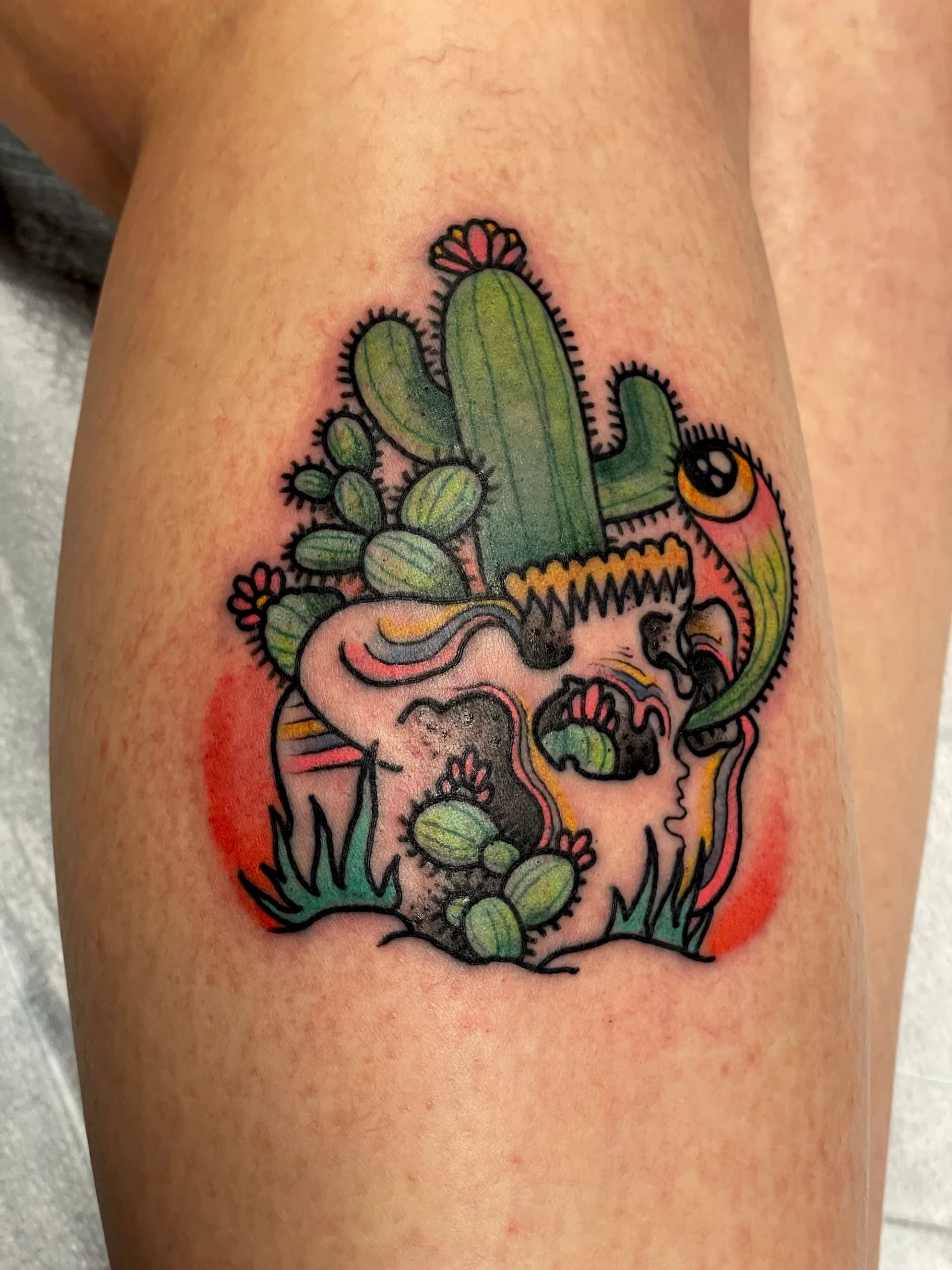
If you've been looking at tattoo styles, you've probably come across both "Traditional" and "Neo-Traditional" — and they can look pretty similar at first glance. They share DNA, but they're different animals. Here's an honest breakdown from someone who tattoos both.
Traditional (American Traditional / Old School)
Traditional tattooing — also called American Traditional or Old School — is the foundation of Western tattooing. It's the style that soldiers brought home from the Pacific, the style you see on the walls of every classic tattoo shop in North America. It's been around for over a century, and there's a reason it's still one of the most popular styles today: it ages like nothing else.
The Rules
Traditional tattooing has strict rules, and those rules are what make it work.
Bold black outlines. Every element is defined by thick, consistent black lines. This is what gives traditional tattoos their staying power. Those lines hold up over decades while other styles can blur and fade.
Limited colour palette. Classic traditional uses a focused set of colours — red, green, yellow, blue, and black. That's it. No gradients, no blending between colours. Each colour sits in its own defined area, separated by those black outlines.
Solid colour fills. Colours are applied flat and saturated. There's no subtle shading within a single colour area — it's bold, punchy, and unapologetic.
Iconic subjects. Roses, eagles, panthers, daggers, anchors, skulls, ships, pin-up ladies, swallows, snakes. These subjects have been tattooed for generations because they work. The compositions are proven, the designs are timeless, and they read clearly from across a room.
Two-dimensional design. Traditional tattoos don't try to create the illusion of three-dimensional depth. They're graphic, almost like illustrations. That flatness is intentional and part of what makes the style so visually bold.
Why It Works
Traditional tattoos are designed to last. The bold outlines prevent colours from bleeding into each other over time. The limited palette means fewer colours to fade. The solid fills don't rely on subtle gradients that soften with age. A well-executed traditional tattoo at 20 years old will still look like a tattoo — not a blurry bruise.
Neo-Traditional
Neo-Traditional emerged as artists who loved traditional tattooing wanted to push the boundaries while keeping the foundation. It respects the roots but bends the rules.
What Changed
Outlines are still present, but more varied. Neo-Traditional keeps bold outlines — that's the traditional DNA — but line weights vary more. You'll see thicker outlines on main elements and thinner, more delicate lines for details. This creates more visual depth.
Expanded colour palette. Where traditional sticks to a handful of colours, neo-traditional opens the door to a much wider range — purples, pinks, oranges, muted earth tones, and complex colour blending. Gradients and transitions between colours are common.
Detailed shading and depth. This is where the biggest visual difference lives. Neo-traditional pieces use more sophisticated shading techniques to create dimension, texture, and a sense of depth that traditional intentionally avoids.
Broader subject matter. Neo-traditional artists take on a wider range of subjects — animals, portraits, fantasy elements, ornamental details, florals, and compositions that wouldn't fit within traditional's established imagery. The style is more open to experimentation.
Illustrative quality. Neo-traditional pieces often have a more illustrative, almost storybook quality. Decorative elements like filigree, gems, and ornamental frames are common additions that you'd never see in a traditional tattoo.
The Trade-Off
More detail and complexity means more to maintain over time. Neo-traditional tattoos can age beautifully when executed well, but the subtle gradients and fine details are more susceptible to softening than traditional's bold, flat fills. This isn't a knock on the style — it's just the reality of how skin holds pigment over decades.
Side by Side
| Element | Traditional | Neo-Traditional | |---------|-------------|-----------------| | Outlines | Thick, uniform weight | Varied line weights | | Colours | Limited (red, green, yellow, blue, black) | Expanded palette with gradients | | Shading | Minimal, flat fills | Detailed, dimensional | | Subjects | Classic icons (roses, eagles, etc.) | Broader, more experimental | | Depth | Two-dimensional, graphic | Three-dimensional, illustrative | | Aging | Extremely resilient | Ages well but needs more care | | Detail level | Simplified, bold | Complex, intricate |
Which One Is Right for You?
There's no wrong answer here. It depends on what you're drawn to visually and how you think about tattoos.
Go Traditional if:
- You want something that will look rock-solid in 30 years
- You're drawn to bold, graphic imagery
- You appreciate the history and rules of the craft
- You want a tattoo that reads clearly at any distance
Go Neo-Traditional if:
- You want more detail, depth, and colour variety
- You're drawn to illustrative, decorative aesthetics
- You want to push a subject beyond classic constraints
- You appreciate the traditional foundation but want something more contemporary
Or mix them. A lot of my work lives in the space between these two styles. I love traditional composition and bold outlines, but I'll pull in neo-traditional colour work or shading when it serves the design. The categories aren't walls — they're guidelines.
Want to explore either style? I do both and everything in between. Book a consultation and let's figure out what fits your vision.
Written by
Nate
25 years of tattoo experience at Village Tattoo Company, London, Ontario.
Book a Consultation