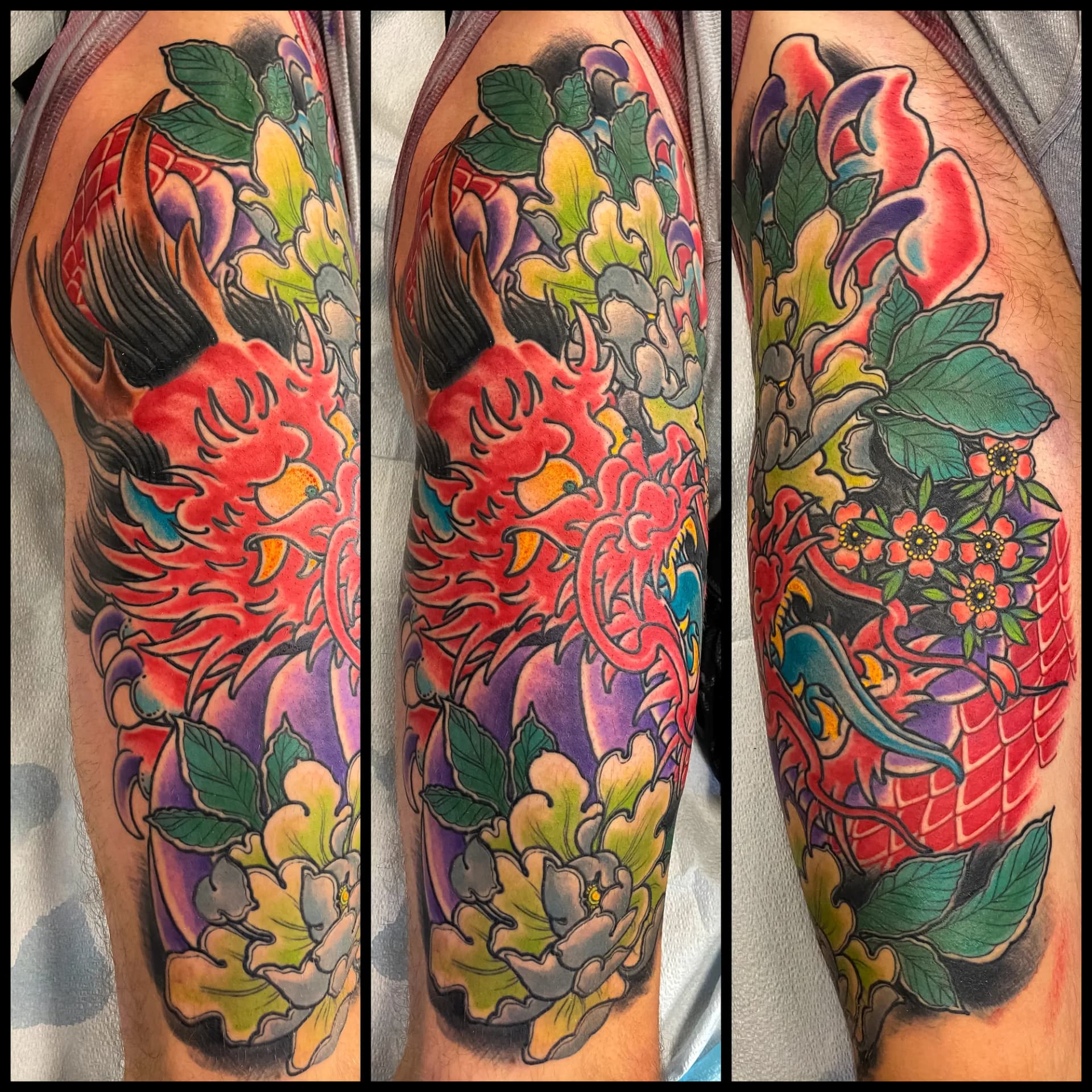
Japanese tattooing is one of the oldest and most respected traditions in the art form. It's also one of my biggest passions — I've spent years studying the rules, the compositions, and the stories behind the imagery. If you're considering a Japanese piece, understanding a bit of the background makes the whole experience richer.
A Living Tradition
Japanese tattooing — called irezumi — has roots that stretch back centuries. What makes it unique isn't just the subject matter. It's the way the entire body is treated as a canvas. Traditional Japanese work follows specific rules about flow, composition, and how different elements interact with the body's natural shapes.
A Japanese sleeve isn't a collection of random images placed next to each other. It's a unified composition where wind bars, waves, clouds, and backgrounds connect everything into a single flowing piece. The background is just as important as the main subject.
The Major Subjects
Dragons (Ryū)
Dragons are probably the most iconic subject in Japanese tattooing. Unlike Western dragons, Japanese dragons are wise, benevolent creatures associated with water, storms, and protection. They're often depicted weaving through clouds or waves, and they work beautifully as large-scale pieces — full sleeves, back pieces, or chest panels.
I've done dragons in full colour and in black and grey. Both approaches have their own power. Colour lets you play with traditional palettes — golds, greens, reds against dark backgrounds. Black and grey gives them a more dramatic, almost cinematic feel.
Koi Fish
Koi represent perseverance and determination. The legend says a koi that successfully swims upstream and leaps over the Dragon Gate waterfall transforms into a dragon. That story of struggle and transformation resonates with a lot of people.
Koi are incredibly versatile in composition. They pair naturally with water, maple leaves, lotus flowers, and cherry blossoms. A koi swimming upstream versus downstream actually carries different symbolism — upstream represents ongoing struggle, while downstream can represent having already achieved your goals.
Foo Dogs (Komainu / Shishi)
Foo dogs are guardian figures — you'll see them flanking the entrances of temples and shrines throughout Japan. In tattooing, they represent protection and strength. They have an expressive, almost fierce playfulness to them that makes them incredibly fun to draw and tattoo.
They work as standalone pieces or as part of larger compositions. I love placing them on forearms, upper arms, or as part of a full sleeve with complementary elements.
Hannya Masks
The hannya is one of the most visually striking subjects in Japanese tattooing. It's a mask from Noh theatre that represents a woman consumed by jealousy and rage — but there's more nuance to it than that. The mask actually shows the transformation between human emotion and something darker, and depending on the angle you view it from, the expression shifts between sorrow and fury.
Hannya masks pair well with serpents, cherry blossoms, and peonies. They're a popular choice for hands, chest pieces, and as focal points in larger sleeves.
Peonies (Botan)
Peonies are called the "King of Flowers" in Japanese culture. They represent wealth, elegance, and bravery — which might seem contradictory, but in the tattoo tradition, beauty and courage go hand in hand. Peonies are the most common background flower in Japanese work, and for good reason. Their large, layered petals fill space beautifully and create visual depth.
Cherry Blossoms (Sakura)
Cherry blossoms represent the fleeting nature of life. They bloom briefly and fall — a reminder that nothing is permanent. In Japanese tattooing, scattered cherry blossoms often fill the background of a piece, carried by wind. They add movement and an element of poetry to any composition.
Colour vs. Black and Grey
This is one of the most common questions I get from clients considering Japanese work. Both approaches are valid and both have a long history.
Full colour is the traditional route. Rich reds, deep greens, golds, and blues against skin or dark shading create the bold, vibrant look most people picture when they think of Japanese tattoos. Colour pieces age well when properly executed and cared for — especially with sun protection.
Black and grey has become increasingly popular and gives Japanese subjects a completely different atmosphere. It's moodier, more dramatic, and in some ways lets the composition and linework take centre stage without colour competing for attention. I do a lot of Japanese black and grey work, and it's a style I keep coming back to.
Planning a Japanese Piece
Japanese tattooing works best when you think long-term. If you're considering a sleeve, a back piece, or even a half sleeve, it helps to have a conversation about the full vision from the start — even if you build it over multiple sessions.
Here's what I recommend:
- Think about placement first. Japanese work is designed to flow with the body. A forearm, a full sleeve, a thigh — each placement has compositions that work naturally.
- Pick your main subject. Dragon, koi, foo dog, hannya, samurai, phoenix — what resonates with you?
- Let the background develop. Wind bars, waves, clouds, and flowers aren't afterthoughts. They're what tie the piece together.
- Trust the process. I'll create a custom design that respects the tradition while being completely unique to you.
If you're interested in Japanese tattooing, I'd love to have a conversation about what you're envisioning. Book a consultation and we'll start building something meaningful.
Ready to start? Get in touch or DM me on Instagram (@nate_tattoos).
Written by
Nate
25 years of tattoo experience at Village Tattoo Company, London, Ontario.
Book a Consultation